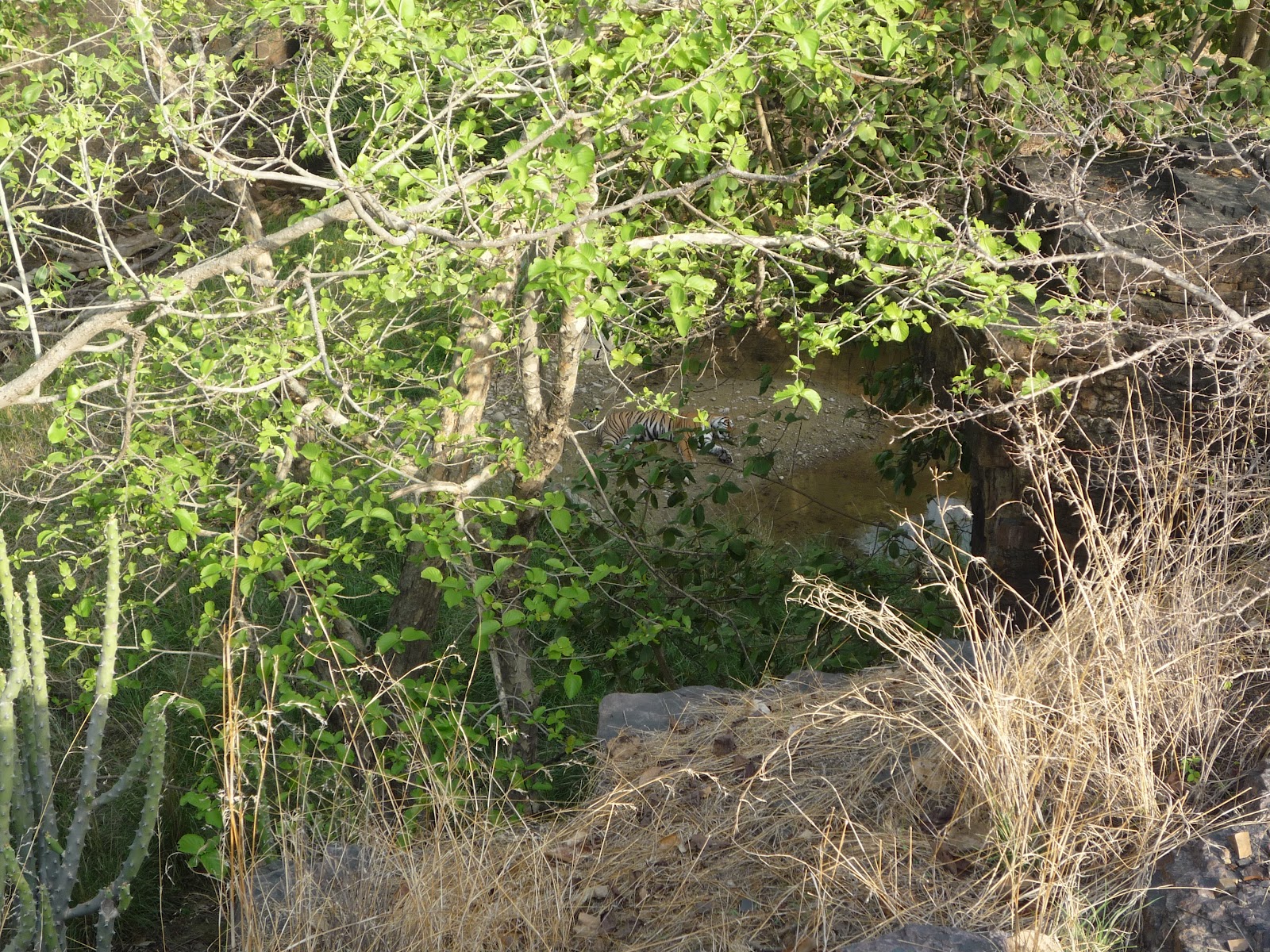
An entirely different experience from the earlier trip (May 2010). This time, we were a group of 5 intrepid women, down from a peak group size of 14. I had made arrangements through Ojha Holidays, which I was told was one of the nodal agencies who directly liaised with the Chinese authorities and through whom other agents worked. Since we were down to a group of five, I realized we would be attached to another group, to make up the minimum (economic) group size, which to my understanding is 20-22.
The first surprise happened when we landed at Kathmandu airport on June 17, 2013, where casual questioning of the guys who came to receive us yielded information that we were joining a group of ~70! We were all put up at different hotels (Yak and Yeti was where we had chosen to stay – nice hotel, by the way). A settling down in rooms, some food and we headed towards Thamel in search of coffee. We had to be back in the hotel by ~6:30 pm for a briefing by Ramesh Ojha (agent). Of course, time means nothing in these situations, and after a long delay, Ramesh Ojha made his entrance, handed us our duffle bags and back packs with the news that we would be visiting Pashupatinath temple the next morning, and then leaving Kathmandu post lunch, by something like 2 pm!
 |
| Pashupatinath Temple |
 |
| Reclining Vishnu |
So, there went our plans to shop in Thamel and we just hurried off to our rooms to repack, eat dinner (nice buffet) and crash. Next morning, June 18, after a long wait post breakfast, we visited Pashupatinath and the reclining Vishnu (first time I’ve seen a Vishnu reclining on his back in suptabhaddakona asana!). We returned at something like 2 pm, checked out and around 3 pm, headed to the buses for the trip to the border town of Kodari.
Lesson number 1 for anyone wanting to make this trip: Try and ensure you are in a group of your own comprising ~20 people. Ensure your agent makes all arrangements specifically for your group of 20, including a guide, sherpas and kitchen truck + staff dedicated to your group for the entire duration of the trip. Otherwise, you will spend forever and ever waiting around while the agent arranges the logistics and nobody will have any information about when transportation will arrive and when you will actually move. Kathmandu has narrow streets and too much traffic, not to mention the confusion added by the monsoons. So transit times within Kathmandu are totally unpredictable. Having your own group, all staying at one hotel, will greatly address this issue
Lesson number 2: Be prepared for long waits and little information. If you do not face it, good! And if you are able to follow lesson number 1, this problem should anyway get addressed to some extent at least. But if you do encounter it, better to face it with equanimity rather than losing your head over it, because this trip is as much about facing everything that comes your way with equanimity, as about physical fitness. Being impatient and intolerant of rampant inefficiency and absence of information, achieves absolutely nothing other than frayed nerves for everyone in the group
Finally, a bus made its appearance and we clambered in with a few others from the same hotel. We wended our way through the streets of Kathmandu stopping at a couple of other hotels and picking up more people until we finally headed out of Kathmandu. By the time we reached the border town of Tatopani, Nepal, it was dark. So the scenic portions of Nepal were missed on this outward trip. At Tatopani, we were put up in Sonam Guest House, a narrow vertical structure where we were allotted a 5 bed room with an attached toilet (a great luxury considering others were sharing communal toilets and bathrooms -1 per floor). The idea was that we would stay at Tatopani overnight and next morning, after Ramesh Ojha brought the Tibet permit (which was to arrive from Delhi by a morning flight), we would cross the border and head to Nyaalam, Tibet
 |
| Dining Room - Sonam guesthouse, Tatopani |
 |
| Tatopani - one street border town |
Next morning, June 19, we waited and waited for news (the same old story of polite helpless smiles and no information) until sometime towards afternoon, we were told the flight from Delhi was delayed landing in Kathmandu due to rains and so we would now only cross the border the next morning. So, an extra day in Tatopani, exploring the streets, visiting the hot springs and beautiful garden around it, the hillside Buddha (tantric – Padmasambhava?), shopping for prayer shawls and a sweater to replace Kripa’s lost sweater … This was also where we started taking Diamox, with the result that some of us started feeling fatigued, headachy, loss of appetite / nausea etc. This we were told is a normal side effect of Diamox and would last 2-3 days until the body got accustomed to the Diamox
Lesson 3: Start taking Diamox about 2-3 days before you reach high altitude, as it takes the body that long to get used to it, i.e. for you to overcome the side effects
 |
| Bags awaiting loading - identified by color and number |
 |
| Playing with Tatopani kidswhile waiting |
Next morning, June 20, we were ready bright and early, and as instructed carried our duffle bags down for loading into the bus, before breakfast at 6:30 am. Returning from breakfast, we find our duffle bags still lying on the roadside – a couple of busloads have departed, but we are still awaiting our bus – maybe they were operating a shuttle bus service for this short stretch!
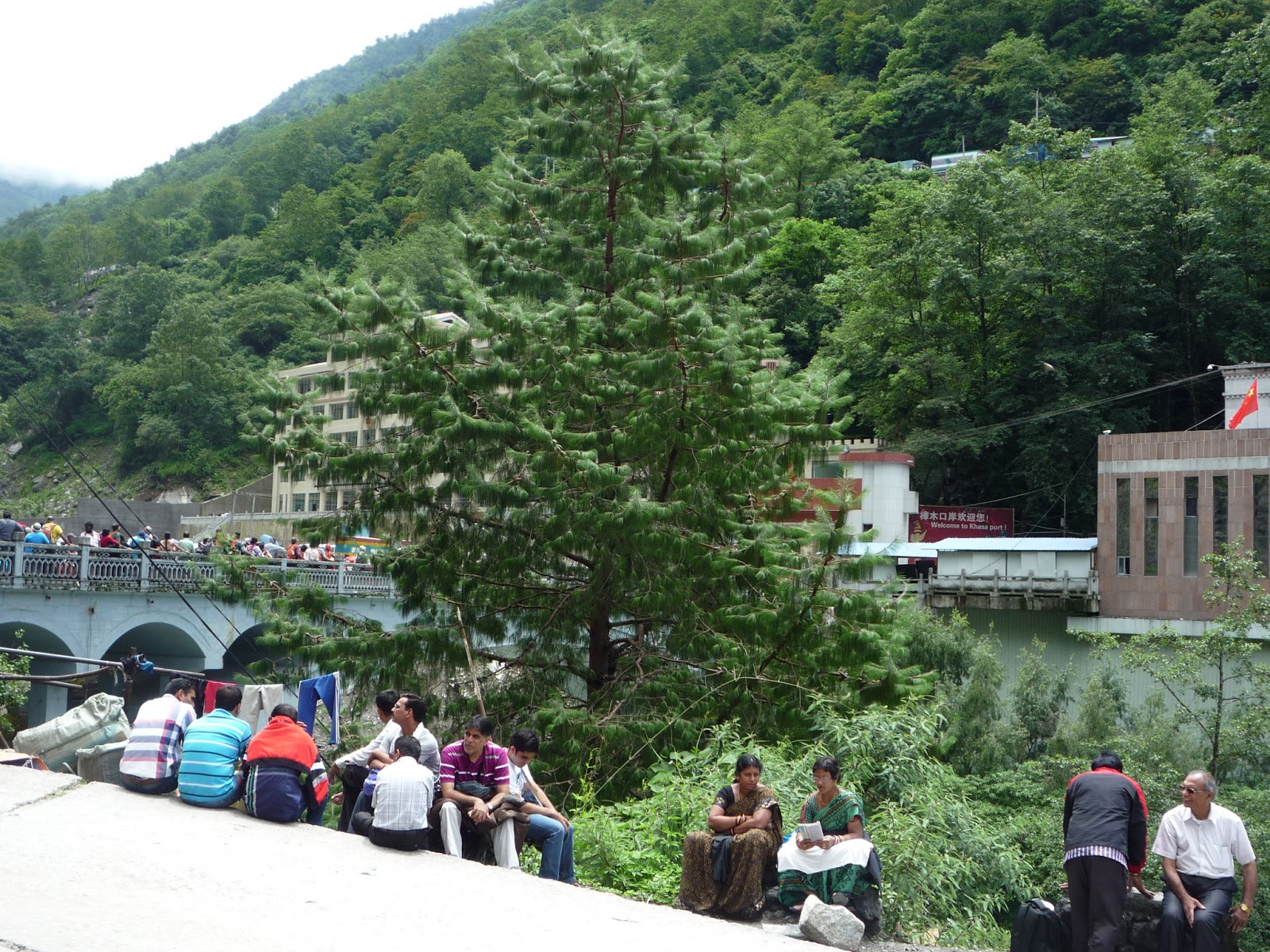
As we waited, bits and pieces of information trickled back – 1500-2000 people were crossing the border that day and there was a long queue on the bridge (for immigration). It was better to wait at Sonam guest house in Tatopani rather than on the bridge (crossover point). It was probably something close to 10 or 11 am when we finally piled into the bus for the border. We disembarked with the rest of our busload and were rapidly pulled aside by one of the organizers – “NRIs (their term for non-Indian passport holders, including foreigners) follow me”. Our motley group of 5 consisted of 1 American, 1 Frenchwoman and 3 Indians. So the 2 non-Indians followed the one guy and the remaining 3 of us followed someone else until of course, the 3 of us found ourselves kind of lost in the huge crowd and queues on the bridge. We stood in a queue for a while frantically looking around to spot someone, anyone, from our busload and Sonam Guest House crowd, with no luck. Finally, Serena persuaded me to go for a look-see and I found a queue of our larger group frantically waving to me to come join them. So back we headed from the bridge to outside the gates
 |
| Queue outside gates to bridge |
 |
| Crowd on bridge |
 |
| Queue on bridge (background) |
All in all, we waited for something like 6-7 hours – first outside the gates to the bridge, then on the bridge itself, then (after crossing the bridge under the watchful dead eyes of baby faced Chinese soldiers) in the courtyard leading to the Chinese Immigration Office. All under the blazing sun, with no seats, no shade, no loos (so we were wary of how much water we drank) and limited food (mostly sweets which we’d brought with the trek in mind, not waiting in the sun on the bridge!)
Lesson 4: On the day you plan to cross the border, keep food that can substitute for lunch handy in your backpack. Your duffle bag will not be accessible to you at this time
We finally crossed over and were reunited with our 2 foreign passport holders. They had had a relatively easy time, having made the crossing in 1-1.5 hours, but were frantic about how long we would take and nowhere to sit while waiting. Finally, they made their way to the bus that was supposed to carry us the next leg, and spread themselves out, “reserving” seats for the 3 of us who were yet to arrive.
One of the people in our larger group was actually turned back from the border because her (Indian) passport validity was expiring in less than 6 months. Unfortunately, her NRI son had already crossed over and finally, the lady told the son to continue with the rest of her group (all her friends and neighbors and contemporaries) and be a support for them, while she finally headed back to Mumbai
Lesson 5: Check that you have passport validity of 6 months and maybe a good idea to have a contingency plan in place in case anyone from the party is refused entry for any reason – will the entire group return / go on, what will the turned back person do – wait in Kathmandu / Kodari / return home – the moment of crisis is probably not the best time to be making this call
Anyway, at something like 3 – 4 pm, we finally crossed over into Tibet (China) and our buses headed to Nyalam, our night stop. We encountered some 3 checkposts on the way, where passports were collected and handed over and retained by the organizers for subsequent checks. Such an oppressive feeling when unsmiling Chinese soldiers give you that dead eyed look and ask questions in Chinese. At some point, I went into hysterics – Question by Chinese soldier : “From where have you come?”. Deeply philosophical answer : “I am going to Kailash to find out”. Question : “Where are you going?”. Answer : “I am going to Kailash to find out!”
Of course, with all these delays, we were all tired, hungry, bad tempered and it was growing dark, so … yet again … we missed out on some of the beautiful scenery through which we presumably passed. To my surprise, I recognized Nyalam even in the dark, as we were put up at the exact same place where we’d stayed in 2010. But a new, improved Nayalam guest house - we now had indoor plumbing – communal co-ed toilets, but with running water and wash basins to brush our teeth. Luxury by earlier standards!
 |
| Sleeping Quarters, Nyalam |
 |
| Nyalam guesthouse |
 |
| Picnic lunch on wayside |
 |
| Lake Peigu Tso (pronouned Pickaachu locally) |
Next morning, June 21, was spent shopping (oxygen tubes, walking sticks, some warm weather trousers and tights and sweaters). It was during this shopping trip that we first encountered breathlessness at the slightest incline or load carrying. This was the first indication that we were at high altitude and short of oxygen. We left Nyalam around 10 – 11 am, for New Dongzpa. Umpteen police checkposts along the way, a picnic lunch break somewhere by the roadside. But for the first time, we were able to enjoy the scenery – the sand dunes, the rugged mountains, the electrifying blue of lakes ....
And so we reached New Dongzpa for our night stop, found ourselves assigned to another room with 6 beds and crashed for the night. I think none of us had the energy to stay up for dinner, since the kitchen truck had been delayed and the sherpas had only reached New Dongzpa along with us at something like 10 -11 pm.
I have not mentioned this explicitly so far, but here’s lesson number 6 : You spend a lot of time just travelling from Point A to Point B, only to reach there, rest-recharge and move on, before you ever reach Mansarovar or Mt Kailash. The journeys are long. In a Land Cruiser, you tend to bounce quite a bit. The roads are tarred for the most part, but they sometimes have potholes (Made in China potholes!) and sometimes there are speed breakers … we found the smoothness of the drive better in a bus. But of course, what you gain in smoothness you give up in flexibility – that’s the trade off
Also, lesson number 7: We had carried a lot of food with the parikrama in mind – so calorie rich, dense foods, typically sweet. We would have dearly loved a lot more of the time-pass munchies kind of food to while away the boredom during the endless drives
 |
| Guesthouse at New Dzongpa |
 |
| Packing and repacking every day |
June 22: Breakfast in the morning and back into the buses, heading for Mansarovar at last. Enjoying the beautiful scenery now and looking forward to reaching Lake Mansarovar, we trundle along.
 |
| Filling water, dipping rudraksha in Lake Mansarovar |
 |
| Scenic view of Lake Mansarovar |
Suddenly, our bus stops, one of the organizers gets into our bus asking our group of 5 to step out and into a Land Cruiser. This is where our group parts company from the rest of the group, in line with our expedited schedule. So with our day bags (backpacks) and hopefully nothing left behind in the sudden switch, we settle ourselves into the Land Cruiser with driver Karma, and zip towards Lake Mansarovar. We enjoy our first sight of Mt Kailash and Lake Mansarovar and then Karma takes us to a place where we can comfortably wade into the lake. We all wade in, dipping our rudrakshas and filling our water bottles. The water is cold, but not uncomfortably so – quite bearable. None of us is inspired to dip under water though. As I come out of the water, I become aware of how chill the wind is and my legs feel cold. Almost in a panic, I come back to the Land Cruiser to grab my towel and dry off before I catch a chill
Lesson 8: Keep your towel handy (even slung round your neck) when you wade / dip in the lake – even if the lake itself is sunwarmed, the windchill when you come out of the water is considerable and there is a high risk of exposure
The next day, we heard the story of some lady in a group a couple of days ahead of us – she’d forgotten to take her high blood pressure medication, stayed underwater for 3 minutes in a surfeit of devotion and then succumbed to hypothermia before she could be taken to where medical assistance was available. So, Lesson number 9: You are responsible for your own well being. Make sure you’re taking all the medications you need to take regularly and do not try foolish things like dipping in the water and not drying off immediately – even if the sun is warm, the wind blowing off the glaciers is chill. In fact, it is probably safest not to dip in the water, but just take a small handful and pour it over your head, if at all you feel you absolutely must
While the lady in question might have felt that she achieved moksha / nirvana by dying at Mansarovar, she left her entire group traumatized by the incident, not to mention the bureaucratic headache involved in bring her body back to India.
 |
| Base camp, Lake Mansarovar |

 |
| Hot salted Tibetan tea at Mansarovar |
After our dip and water collection, we headed to the base camp of Chu Gompa (?) where we indulged in a couple of cups of tibetan tea each with salt (and no yak milk or yak butter) while our duffle bags were identified and pulled from the general truck into our Land Cruiser. Due to our expedited schedule, we sacrificed a night stay at Lake Mansarovar
Duffle bags loaded into the Land Cruiser, we headed on to Darchen, where we joined a group who were a day ahead of us and planning to start their parikrama next morning. This group happened to be led by the Shankaracharya of Hampi, and comprised some 40 odd people. A more manageable number than the 70 and 150 that we’d been attached to thus far! This group was led by Basanta Baral, brother in law of Ramesh and Govind Ojha, joint proprietors of Ojha Travels and overall a guy with MUCH better organizational and leadership skills than either of the Ojha brothers
 |
| Full moon viewed from Darchen |
 |
| Mt Kailash watching the door |
A night spent at Darchen, where the full moon woke up Kripa in the middle of the night by shining full on her face and Mt Kailash brooded over the entrance to our door on the other side

 |
|
North Face, Mt Kailash - Ganesha in profile on right, Shiva front face facing
|
The first day’s trek was easy – a gradual incline where there was one, and many plain stretches. The challenge came purely from the lack of oxygen. A short 15 degree incline, barely 10-12 feet long could require a stop or two before reaching the top, simply because we felt out of breath and could feel our hearts thumping in our chests. Also, due to the size of the crowd and the shortage of porters, we were carrying a small back pack each, which started to assume significant proportions as the walk continued. The down jacket we were each carrying also started to become a nuisance, given the warmth of the sun beating down upon us. So with faces smeared with sunblock, heads covered as much as possible against the sun and struggling with warm clothes that we did not need, we completed the first day of the trek and reached the base camp of Deraphuk at the base of the famous North Face of Mt Kailash
 |
| Carousing customers at our chai stall night quarters |
 |
| Sleeping baby in our night quarters |
 |
| Sunrise on Mt Kailash, North Face |
June 24. We photographed Mt Kailash glowing golden in the rising sun, and then headed for breakfast. At breakfast, we were informed quite categorically that there had been 5 feet of snow and ice in the mountains and nobody would be allowed to proceed on the parikrama – everyone had to turn back and head back to Darchen. Given the tightness of our schedule (we each had to reach Kathmandu on June 26 to catch our respective flights back on June 27 and then Val was to fly from Singapore (her home base) to France with her son on June 28th night!), I thought it just as well we did not risk bad weather getting us stuck in the mountains. So we took a photo with our landlady for the night with her cute little baby and set out to return to Yama Dwar and Darchen
Based on our experience of the previous day, we loaded all our down jackets and thermals into the bags for the porters and clad in light clothes covered by a wind cheater in my case, we set out. And lo, the weather turned round and decided to be a cloudy overcast day. Towards the end of my trek (and I was amongst the last to finish), we got caught in a bit of icy rain and hail storm. I was happy to have my windcheater on. By the time I pulled my gloves out of my pocket and wore them, my fingers were red and shaking and I truly thought I would have to explain to people how the backs of my hands were sunburnt while the fingers had chilblains! The big achievement of this day however was, that I managed to spot the well camouflaged deer on the mountain side and point them out to Sushmita with whom I was walking. I blindly pointed my camera at them and shot them, hoping against hope that I would capture them. The camouflaging is so perfect that you cannot spot them unless they move

End of the parikrama, back to Darchen for a quick lunch, luggage segregation from the rest of the group, a chat and photo op with the Shankaracharya of Hampi while Sushmita changed out of her wet clothes and then we piled into the Land Cruiser with Karma to start our homeward journey.
 |
| With Shankaracharya of Hampi |
 At this time, we discovered that someone from the group had slapped their pony man, and the cops were on the premises wanting to throw the offender in jail – Chinese jail! Since we left before the issue got resolved, we have no idea how it ended up. The negotiations were continuing about 2-3 hours into the police arriving, so it was obviously not an easy matter to resolve. So Lesson 10: You may consider yourself to be on a Hindu / Jain / Buddhist pilgrimage, but do not ever forget you are a foreigner in Chinese territory. And the Chinese police are known for their brutality, lack of reason, conviction without a hearing etc. etc. Take no chances and be afraid at all times of doing anything that the Chinese may perceive as wrong doing.
  |
| Low hanging clouds at New Dzongpa |
 |
| Freshly ground coffee at Saga |
June 25. Karma was visibly upset that the local inn keeper had vamoosed and not kept her promise to give us tea and breakfast (Jhoot bolna achha nahin hai, he muttered – it is not good to tell lies), so we drove off in search of an elusive neighborhood chai stall. It took us all the way to Saga, around 11 am – 12 noon to find one, but what a café that was. Blue Mountain Roast – a premium decoction coffee brand - coffee made with freshly ground beans and Chinese pao for breakfast at 11 am. After that break, we pressed on and somewhere around 4-5 pm on the 25th, we reached Zangmu – the border town on the Tibetan side of the Nepal-Tibet border.
It was Val’s birthday, and it turned out that Karma ran a restaurant in Zangmu, so after a quick washup (indoor plumbing – we were back to civilization even if it was a communal loo!), we all headed off to a well earned dinner at Karma’s restaurant – Val’s birthday treat to us all. With pretty much no breakfast or lunch, we were all hungry – we’d also stopped taking Diamox the previous day – so we went to town and pigged out on steamed vegetarian and fried yak momos, thukpa soup (which came in such a large bowl, it was a meal in itself) and some chow mein. Helped along by constantly refilled mugs of jasmine green tea, we ate till we could no longer stand and then tottered back to our hotel for the night
June 26. A hearty breakfast at the café attached to our hotel after which we headed to the border enjoying the tree filled gorges and waterfalls en route. Numerous stops for police verification – saala police (damn police), as Karma referred to them with the right intonation and venom in his voice and then we had about an hour or so of waiting before we crossed the bridge and were back in Nepal! For all of us, we felt we had escaped China and were back on home territory – so oppressive is the police presence and atmosphere in Tibet
On the Nepal side, we piled into a Scorpio driven by a very stylish young man who said his name was Shekhar. To the beat of filmi music, we took to the road and this time, were able to enjoy the scenery that we’d missed in the dark coming out. Despite checks by the Nepali police – at one stage, a young soldier clambered onto the roof of our Scorpio in his hobnailed boots, leading Shekhar to yell in despair and pound the roof from the inside to straighten out the dents! – we made it back to Kathmandu at about 3:30 pm on 26th. What a relief.
Some inevitable mix ups – with Ramesh Ojha, it seems to be inevitable – we had no bookings at Yak and Yeti, roundly refused to be shunted off to Manuslu as it was too far from Thamel where we wanted to go for shopping and insisted in being put up at Shangri La. Checked in, had a much awaited bath (8 days since our last bath!) and then headed to Thamel for some shopping. Back to the hotel and the bottle of Champagne Val had brought for the occasion followed by dinner, packing and sleep (after I’d managed to lock myself in the bathroom and had to be rescued by having the door knob dismantled after 1 hour of struggle by the hotel staff – ShangriLa standard is much fallen since 2010 despite having been renovated since then). The next morning, 3 of us were leaving at 7 am for a 10 am flight, so we just about enjoyed the buffet breakfast together before we split up – 3 of us to Mumbai, 1 to Delhi en route to the USA after 5 days and 1 to Singapore to pick up her son and then head off the next day to France on vacation!
Highlights of Dos and Don’ts :
- Be mentally prepared that you will spend a lot of time travelling and waiting around, and it may all be for nothing – if weather is bad, you may not be able to even attempt the parikrama (circumambulation) of Mt Kailash. Or you may do Day 1 of the parikrama (it is a 3 day trek), and have to turn back without being allowed to attempt Day 2 and 3. Or you may do Day 1 of the parikrama but have such bad weather (clouds, rains etc.) that you cannot really see anything of the mountain or surroundings. The Sherpas warned us repeatedly of this in 2010 – the weather is unpredictable – people one day ahead or behind you may have a totally different experience from you. If Lord Shiva permits you, you may see Him, and complete the parikrama. If not, you will not be able to do anything about it and you HAVE to obey the guides when they advice you for or against the trek. We heard one of our guides was jailed for 2 days on an earlier occasion because he insisted on leading a group through day 2 of the parikrama despite being warned against it by the Chinese authorities. Which is understandable given that the latter would have to risk their own lives for rescue operations if things go wrong
- Ideally, form your own group of 20-22 people and ensure your agent is treating your group as an exclusive unit, with dedicated resources (guide, sherpas, kitchen equipment and staff, China guide)
- In case you have any non-Indian passport holders in the group, be aware that the Chinese government wants at least 5 passports to be from a single country before they will process the permit. This seems to be a not so strictly enforced rule, since in the entire larger group (of over 150 people) we only had 1 French passport holder. However, it is probably best to check this thoroughly with the agent before you firm up your plans. At any rate, it is probably advisable to have at least 5 non-Indian passport holders as a critical mass within the group. Note, that the agent may refer to foreign passport holders as “NRIs” – do not get misled by the misuse of the tern NRI – they mean non-Indian passport – nothing to do with country of residence
- Travel in Kathmandu is invariably by bus. If you have your own group, bus travel in Tibet is more comfortable – less bouncing around. If you are not in your own group, a Land Cruiser gives you more flexibility in terms of not having to wait for the group when leaving, stopping for bio breaks etc. But I did see instances of Land Cruisers getting ruthlessly commandeered for ferrying people who were feeling unwell (high altitude sickness) to hospital. So you might end up paying for a Land Cruiser and then getting squeezed into a bus
- Avoid full moon trips – with 1500 – 2000 people crossing the border in time for it, and the Chinese least interested in providing any facilities or expediting the process, the border crossing becomes extremely painful. If you are going to cross over on such a day, ensure you are carrying something to shade you from the sun, protection in case it starts raining, food – as in lunch, not just munchies, water / soft drinks to stay hydrated (remember, you should be on Diamox by this time), maybe a book or music or something to keep you calm and entertained. Remember though – no politically sensitive reading material – nothing to do with Buddhism, Dalai Lama, Freedom for Tibet, Communism, Chinese occupation of Tibet etc. Best case - the Chinese will confiscate it, worst case – they will throw you in prison!
- Take no photographs on the bridge crossing between Nepal and Tibet – the Chinese can arrest you for it. While there are signages warning of this, it is easy to miss them in the midst of all the crowds and there is no reasoning with the Chinese authorities
- Between one trip that I undertook in May (2010) and one trip in June (2013) which is a better month to go – hard to answer. In May, we felt miserably cold almost all the time once we reached Nyalam; and on the trip back, till we reached Zangmu. In June, the weather was more comfortable – in fact, uncomfortably hot at times. But June brought the rains and associated uncertainties due to delayed flights, delayed permits, the possibility of landslides and delays en route, getting stuck etc etc. We all acclimatized more easily this time – I am not sure whether it was just that last time, we were so miserable with the cold that we found it harder to acclimatize
- Diamox is a must. People in our larger group who had not taken it were found puking their guts out at Nyalam and later. While it is true that it leads to loss of appetite, nausea etc etc at least until the body gets used to it (48 – 72 hours), the effects of not taking it seem to be worse. Start taking it 48-72 hours before you hit high altitude (Nyalam on this route). The body takes that much time to start absorbing it and restoring the body to normal pH (with decreased oxygen we tend to breath faster, making the body pH alkaline. Diamox helps to restore the body to normal pH). You can stop taking it as soon as you start the descent (in our case, we took our last dose in the morning when we left New Dzongpa on the return trip)
- You are responsible for your own health and well being. Do not miss any medications that you need to take regularly. If you feel unwell, inform the organizers (agents) – they are usually at least somewhat trained in what symptoms to look out for and will take you to a lower altitude if they deem it necessary for your well being. At the same time, do not push yourself beyond your physical capabilities, especially if you feel your heart thumping, breathing accelerate too much
- Keep a wind cheater / rain coat with you at all times – even when the sun is hot, it only takes a cloud to cover the sun for it to turn chill, or to start raining
- Keep food rations and munchies for non-parikrama days beside special food for parikrama days. The latter can be cheese (tastes really good at that altitude), dry fruits, nuts and chikkis (til is supposed to be best in terms of high oil content). Hot water is freely available at every tea stall and rest stop in Tibet. So it is a good idea to keep soup sachets (the kind which do not require cooking) handy – empty a soup sachet in your flask, add hot water, shake and hold for 1 minute, sip over the next couple of hours
- I have now experienced 2 agents – Ojha Travels, who is supposed to be a nodal agency for many smaller agents and Prakash Shreshtha (who presumably connects up with Shreshtha Travels – a name that kept recurring on this trip). Of the 2, Shreshtha was definitely better – possibly in part because we had our own group of 22 people and a dedicated set of resources throughout. Ramesh Ojha appears to be a guy who believes in sending as large a group as possible with the same set of resources. I heard at one stage that he had combined 7 groups into one, and our group size at New Dzongpa was 156. This makes the group totally unwieldy at the best of times. With poor organizational and leadership skills and frequent Chinese nitpicking, the challenge is greatly compounded
- Indian rupees work in Nepal, so no need (in fact better to avoid) to exchange money in Nepal. 1.6 Nepali Rupees (1.6 NPR) = 1 Indian Rupee (INR) or Indian Currency (IC), as they call it. You do need to change money for China though. In 2010, it was INR 8 / Yuan. In 2013, it was INR 10.3 / Yuan. How many Yuan to carry is a big question. In 2010, the cost of a pony / mule was 1000 Yuan. In 2013, we were told it was in the range of 1200-1700 Yuan while changing money at Tatopani. We none of us expected to need a mule, but guides advice us to carry enough to hire one in case of a medical emergency. When we actually started the parikrama, free market dynamics had pushed the price of a pony to 2000 Yuan (for the entire 3 days trip, which remains unchanged even if you return after 1 day)! A porter to carry our backpack was 600 Yuan (again for the duration, whether 2 days or 3). These are the only expensive items. (Note: A pony cannot be shared – we had intended to hire one pony between the 5 of us, in case of a medical emergency and to carry our backpacks. We were told the pony would be attached to one individual (whoever hired it) – if anyone else fell ill / suffered a broken leg etc, the pony would not be available to that person. I am not sure to what extent that is true – with no language in which to communicate, we have no option but to believe what the guides tell us. Also the pony will not carry backpacks – for that you need to hire porters separately. All in all, a way of ensuring employment for local Tibetans and fleecing tourists, but given our inability to carry any loads at that altitude, we have no option). An oxygen cylinder, if you wish to carry your own, is 12 yuan at Nyalam, and if it is not used, they will buy it back for 9 yuan. A walking stick is 15 – 17 Yuan (market dynamics pushed it up to 20-25 Yuan as our group descended on the stores and stock started depleting). Some warm tights we picked up ranged from 55 Yuan to 65 Yuan. A nice warm sweater was 100 Yuan (we were not the world’s best bargainers). A woolen knitted cap with ear flaps was 10 -15 Yuan. Food items tend to be expensive – a cup of instant coffee at Nyalam cost us 25 Yuan per cup (akin to a Starbucks!), while the Blue Mountain Roast freshly ground coffee at Saga was 20 Yuan (there was competition at Saga – many cafes). Nyalam is rich in terms of gear for the mountains – you can pick up gloves, jackets etc. On this trip, Ojha Travels gave us down jackets for the duration, while last time with Shreshtha, they had arranged for a Kathmandu guy to rent us down jackets on need basis (in the region of 700 INR for the duration of the tirp). If you have your own, you might prefer to carry it, but it is certainly not worth buying a down jacket if you (like me) live in a warm climate with no potential to use it other than trips like these.
- With Shreshtha in 2010, we were given hot soup at the start and honey in hot water at the end of every lunch and dinner. Along with watery curries and the amount of water we kept drinking, we felt the need to urinate every hour – which is a benchmark. With the Ojhas, we got soup perhaps at 2 meals during the entire trip and no honey in hot water at all. Overall, I felt we were not getting enough fluids, because we certainly were not emptying our bladders every hour. Of course, this might also have been because it was so much warmer this time, we were losing fluids through sweat and were not only dependent on urination to excrete fluids. While my preoccupation with this may seem gross, it is an important parameter to monitor while at high altitudes
- You do need a mountain stick to climb the mountain. On day 1, it may be possible to manage without it, but on day 2, if you manage to do it, you definitely would need it. It is only ~15 Yuan, so well worth the price. And it collapses neatly into a size that can go into your check in baggage, so not a huge nuisance to transport it back home. Or you could always just give it to somebody else / leave it with the sherpas – for that price, you probably would not mind
- Sunblock, sun protection is as important as cold protection or rain protection. While we all took care of our faces and noses, we forgot our hands. The backs of all our hands were burnt at the end of the parikrama. Luckily, no lasting damage
- Ensure you have 1-2 days buffer in Kathmandu, so that an unavoidable delay in reaching Kathmandu does not make you miss your flight back home. If you are flying international, you might want to leave more of a buffer, simply because landslides are not uncommon in Tibet and Nepal in this season. Also, monsoons in Nepal can cause delays as well
- Remove all jewellery – fingers may swell due to water retention and rings may become a problem. Ear rings, necklaces etc can get tangled up with caps, mufflers etc and get lost, never to be retrieved
- Do nothing to piss off Chinese authorities – I felt many of the people in our larger group (not the 5 of us), were not aware that we were in China and at the mercy of Chinese rules and regulations and were behaving as they might in India (like slapping a pony man!). The Chinese authorities are brutal and there is no reasoning with them – take no chances with them. Also, be very clear that the Chinese authorities in Tibet behave differently from Chinese authorities you may have encountered in Shanghai or Beijing etc, while on a business / tourist visit
- Ensure adequate passport validity (6 months is the norm. I was a few days short, and had checked with the agent beforehand that it would be ok. But better not to take the chance from what I saw on this trip – the Chinese are unpredictable)
- The locals who act as porters and pony hirers during the parikrama are unorganized. I would guess that how many are available on any one day is a big unknown. While the agents will promise to arrange for a pony and / or porters if you need them, be prepared for the event that there is none available and decide what you will do in that eventuality. Depending on your physical fitness, you could carry your own bag, but we found that even a bag weighing less than ½ Kg was something of a strain. Admittedly, the very next day (returning from Deraphuk), we had acclimatized to the extent that we were not panting nearly as much on the inclines
- While I have travelled with friends who carried fancy cameras, the weight does become something of a burden during the parikrama. Passion for photography can carry you through, but do think it over very carefully, since it is not easy to entrust an expensive camera and lenses to a Sherpa or a lumbering yak or a bouncing truck
Things to carry
- Clothes
a. Hot weather wear for Kathmandu - suitable for temple visit (trousers ok, shorts probably not)
b. Hot weather wear for trip from Kathmandu to Nyalam (and return) which can be layered on and off as altitude gained / lost and temp drops / rises. The same may be used for parikrama days as well – weather changes day to day and is totally unpredictable
c. 1- 2 sets of thermal wear - upper and lower (you may never use them or you may use both sets at the same time … the weather is very unpredictable)
d. Warm cap / ear muffs / muffler
e. Multiple pairs of socks
f. Trekking boots (well broken in)
g. Slip on shoes for night time loo visits and while travelling in bus / Land Cruiser – best to have something that can be used with socks in case it is cold
h. Raincoat – windcheater
i. Gloves / mittens
j. Sunglasses
k. Peak cap / sun hat / umbrella (not recommended)
l. Sweater / fleece
m. "Dipping clothes" and towel for Mansarovar dip – I just changed from warm padded tights to shorts, waded in the lake, dried off and changed back into tights
n. Pack all clothes in sari bags / separate plastic packets, partly for protection from dust and partly to keep things segregated in the duffle bag
- Food (Items may be assigned to members within group rather than everyone carrying everything)
a. Munchies for timepass on bus, in car
b. High calorie, dense nutrition food for trek – cheese, chikki, dry fruits, nuts, nutribars which can be made into small packets in individual Ziplocs and kept in jacket pocket at start of each day of parikrama
c. Soup sachets (which do not require any cooking)
d. Tea bags / hot water flavoring to your taste (lemon tea, peach tea, chamomile etc)
e. Meal substitutes (may not be required, but nice to have in case required) for crossing over day and the odd other occasion when the kitchen truck is delayed / you are following a different schedule from the rest of the group
f. Instant tea and / or coffee for those times when the service is delayed ... hot water is almost always available
f. Instant tea and / or coffee for those times when the service is delayed ... hot water is almost always available
- Money
a. Agent payment in whatever form (cash in whatever currency / credit card transaction)
b. Credit card or ATM card – its use may trigger off a warning and / or a card blockage, but in case you are short of cash in Kathmandu, at least you have some means of accessing some cash
c. Cash – INR 30,000 – 35,000 per person (as per rates prevalent in June 2013 during a Full Moon yatra – these rates would vary greatly based on free market dynamics – becoming less during less peak months and days). If you have them, may not be a bad idea to carry ~200 USD as well, as a backup
- Medical and toilet supplies (again, not necessary for everyone to carry everything – items may be assigned to different members of the group)
a. Any medication you take normally
b. Diamox – ½ tablet, taken twice a day. So compute the number you need based on 1 tablet per person per day, from 3 days before you reach Nyalam (or high altitude) till the day you start descending from high altitude
c. Toothbrush, toothpaste, soap / soap gel, deodorant
d. Dusting powder / talcum powder to dust on your feet before donning socks and shoes
e. Boroline / vaseline, similar strong moisturizer
f. Chapstick / lip balm
g. Sun block
h. Sanitary wear, if you might need it
i. Toilet paper
j. Wet wipes
k. Nose mask (not really used by any of us)
l. Hand sanitizer
m. Distinct bottle to use as bum wash bottle, if you want a wet wash / want to avoid littering with toilet paper!
n. Basic first aid kit – band aids, crepe bandage, paracetamol, diarrhoea medication, acidity medication
o. Napkin (for teeth brushing, face washing)
p. Tissues / handkerchief (for leaky nose)
q. Ear plugs (to shut off snoring room mates)
r. Eye mask (for when there is no discernible switch for the room light! Or for sleeping in the bus)
s. Inflatable neck pillow (for sleeping in the bus)
t. Camphor used by a lot of people – we did not use it, except to insert into damp shoes and get rid of bad smell temporarily!
- Others
a. Suitcase with lock which will be left behind in the Kathmandu hotel’s storage facility (unless you come from home base itself with the duffle bag provided by the agent)
b. Ziplocs of small size (1 day’s / 1 meal’s munchies in jacket pocket)
c. Head mounted lamp
d. Thermos water bottle – 750 ml worked well for me on the trip but a smaller one (maybe plastic) is required for carrying on the parikrama – a 750 ml thermos, once filled, seems to weigh a ton up there
e. Trash bags and extra plastic bags, string bags come in useful
f. Camera, cellphone (preferably low tech ones that do not need frequent charging)
g. Extra batteries for head lamp, phone, camera – you cannot be sure of being able to charge your gadget every night at every stop. There was one occasion when I only managed to charge my phone after 4 days and I could only continue using the phone because I was sending a message, waiting for the delivery confirmation and then switching off. Each time, switching on for barely a minute, maybe 3-5 times a day
h. DO NOT CARRY any books etc relating to the Dalai Lama, tibetan freedom struggle, chinese / buddhist doctrine etc.
i. Would suggest not carrying an iPad or laptop or similar gadget - you will not be able to carry it on the trek and it will get thrown around on the yak / bus / truck
j. Mountain poles, if you have them, else they can be bought in Kathmandu / Nyalam
k. Leak proof unbreakable bottle for carrying back Mansarovar water if you wish to. Jerry cans of different sizes can also be bought at Nyalam. Be mindful of weight and airline baggage allowance norms though
l. Pen knife (be careful to pack in check-in bag and not in cabin bag, both while entering and leaving Kathmandu - airline security norms)
More photos on https://plus.google.com/photos/107058469702735067657/albums/5895276848485778161