Friday, April 8, 2011

Lavasa-Goa Photos


Bulbuls loudly celebrate their appreciation of a beautiful new day at Lavasa


On the machaan on the nature trail above Ekaant Lodge at Lavasa

D G Rao gets contemplative on the machaan ...
Mom poses on the machaan ... Western Ghats in the background

Dad on the machaan - dressed in his comfortable muslin "bundi"

Dad, Mhanthu and Mom on the machaan with Warasgaon lake in the background

Check out the binoculars around my neck .... was hardly able to spot any birds though - could hear them but not spot them, or they just moved around too much for me to be able to focus on them

Sheltering under the machaan for some well needed rest before we start the descent

The woods are lovely, dark and deep ....

On the deck of Dasvino Club - Portofino apartments across the lake

The decks of Dasvino Club


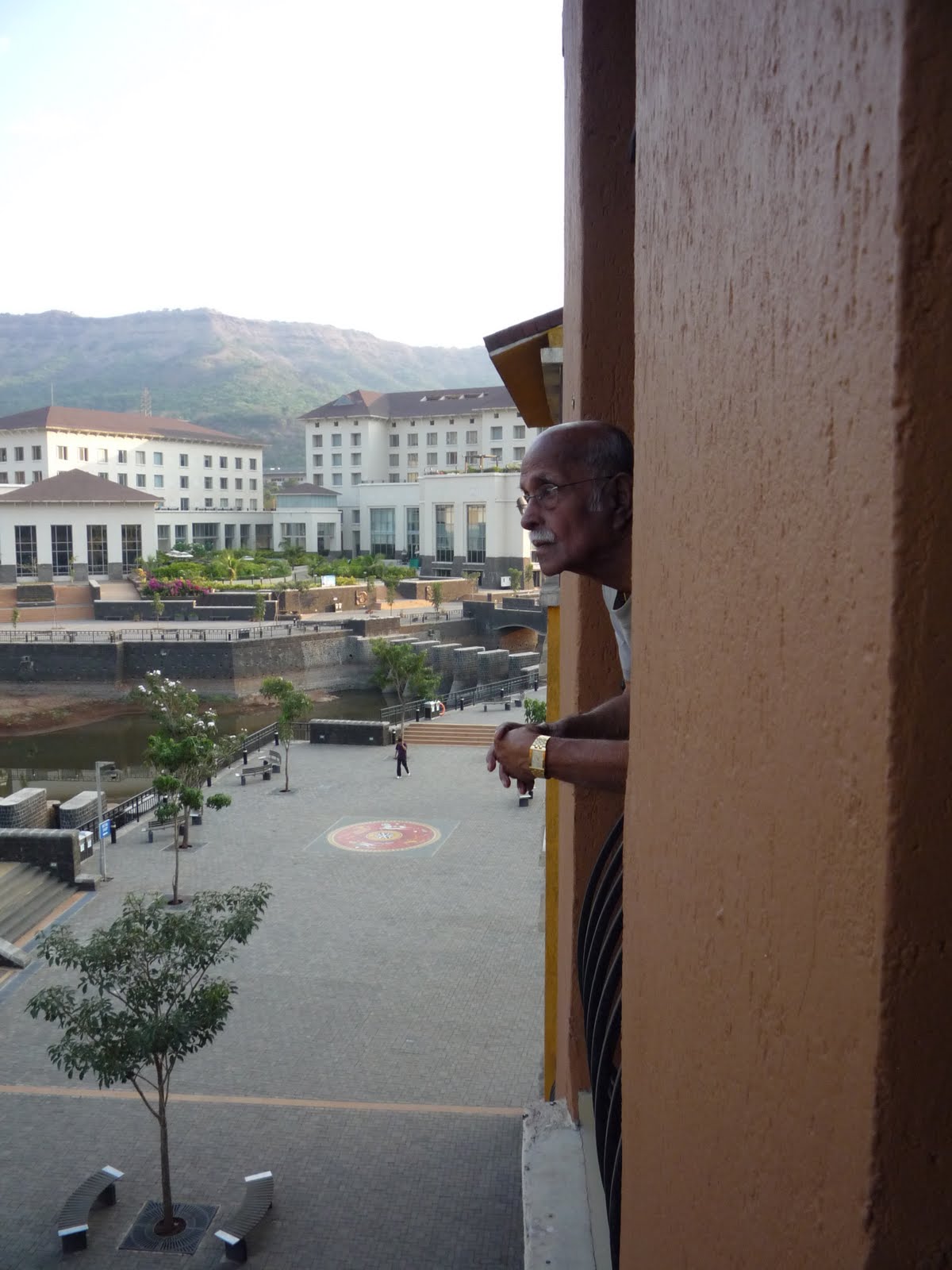
Leaning out of the Waterfront Shaw apartment where we stayed - the ITC Fortune Hotel in the background

Leaning out the Waterfront Shaw, the promenade in the background

Beautiful Buddha statue outside the Convention Center ... loved it


Aravelam Caves from the 6th century AD - came across them by chance on our way tot he Rudreshwar temple near the Haravale Waterfall

The caves .... just before the waterfall

The first cave had this series of depressions in the platform - I imagined it to be Draupadi's chulhas, since we had decided these were Pandava caves ... the archaelogical society notice outside said nothing of the sort!
Five caves, with 5 different shaped lingas ...


The waterfall next to which lies the Rudreshwar temple


Enjoying ht sunset and breeze at Dona Paula with Dinker mam ....
... and Shobha


Wednesday, October 27, 2010

In Search of Spirituality

On Saturday, I finally got round to something that had been in my mind a long time .... I attended a one-day Vipassana session conducted at the new Global Vipassana Pagoda at Gorai (Mumbai). So this blog (after a long silence, since I had no adventure trips to write about) is about Saturday's quest for spirituality!

The trip there was relatively uneventful - as per the website, I thought I would need to take a ferry to reach there, but as it turns out, there is now a land route, which is a bit circuitous, but my driver could drop me right at the doorstep of the global pagoda. The pagoda itself is a lot more impressive from the inside than the outside, because it is a huge place, with not a single internal pillar (support).

I reached by about 10:30 - 10:40 and the session must have started at 11. There were 2 sessions of 1 hour each - both those went well for me (basically guided meditation, 2 different techniques that we'd been taught in the 10 day session). Ideally, one would sit unmoving the entire 1 hour. The first session, I changed position once, but the 2nd session I managed to sit unmovingly, and went into meditative state as well, so was pretty happy with how it went. The hall gives good vibes. There was a lunch break from 1-2, where they served lunch. I ate very lightly, but in spite of that, my mind wandered greatly in the post-lunch session, and I changed position, so that did not go so well. 3-4 was Guruji S N Goenka's talk (all the sessions till then were guided by assistant teachers), and that was the main reason I had wanted to attend - I had never seen/heard him in person. Both he and his wife were in wheelchairs, but his voice was strong enough.

The content of the talk was a bit disappointing, though in his place, I would probably have done the same. The thing is that since Vipassana is the form of meditation devised by the Buddha, a lot of Ambedkar-ites come for these sessions. I'd seen them at Igatpuri and was surprised then, till somebody explained it to me, saying they view it as a sort of pilgrimage - it's a tick mark to be put before you die. There were a lot of similar types here as well, and they were more interested in bowing down to Goenka-ji and such like. So the substance of the talk was that it is not important to deify the Buddha, sing bhajans and put garlands etc etc, the Buddha in fact never founded a religion, what is important is the practice of Vipassana. It possibly had no effect on the masses who bowed their foreheads to the ground as he left, and for me, the topic was not of relevance. But fine, worth a one-time visit. For the future, I would much rather do another 10 day course than attend one of these again

In the middle of the pagoda, there was a 2-tier circular stage (not that I could see it properly, but I figured). On the lower tier (probably barely 1-1.5 feet above ground level, 4 assistant teachers sat, facing four directions. 3 male, one female (the "sadhaks" are also segregated by gender and while here, you could see everyone, in Igatpuri, you never even see the men. When Goenkaji and his wife were brought in their wheelchairs, I realized there was another smaller circular stage above the one where the teachers sat - it was just about big enough for the 2 wheelchairs and 2 helpers. They were positioned on it and he began his talk, and I was a bit disappointed that I could see just his back quarter view. And then, as the talk continued, I realized the inner stage was rotating very very slowly, so that in the entire 1 hour, I could see him full face 3-4 times. Very nice arrangement

I'd sent the car back after dropping me, 'cos my parents wanted to visit someone in Malabar Hill. So I asked the security at the pagoda how I could return, and he told me to follow a crowd who he said were heading to the ferry and to buy a ticket which would cost me Rs 17.50. I duly followed the crowd keeping a casual lookout for a ticket window, but it was pretty sunny so had covered my head and face with my dupatta and had to watch my step as well .... net-net, reached the ferry without spotting a ticket window and asked the EsselWorld guy manning the jetty where I could buy a ticket. He gave me a funny look and told me to just get on now. So I got on, suspecting I was going to be a ticketless traveller.

The entire ferry ride (which was quite pleasant though slow, and the pagoda looked much prettier from the creek, with the rays of the receding sun lighting it us) I kept thinking about how I'd attended a spiritual event and then was doing ticketless travel. So I decided to buy a ticket at the Borivali end. Sure enough, I got off at the other end, spotted the ticket counter and went to buy a ticket - rationale being, what does it matter if the ticket says Borivali-Gorai, what matters is that I've paid for my trip. I hand over 20 bucks and ask for a ticket. The guy prints one out and tells me it is 35. So I say no-no, I want a one-way ticket. He says, you're going there aren't you - you have to come back also (like I needed that explanation, being an idiot). I proudly told him - no, I've already done a ticketless travel from there to here, so now I'm trying to regularize it. The guy is speechless. I don't know whether he didn't understand me. Finally, the other ticket seller (who was watching all this tamasha, since nobody was buying tickets at 5 in the evening), told him - return her money. So this guy thrusts my 20 bucks at me. Now I'm at a loss. So finally .... I ended up buying a return ticket for 35 to assuage my conscience!!!

Then to reach Bandra somehow. Every locality has its own conventions, right? So autos are drawing up, people are piling into them and autos are taking off, without anyone saying a word. It is obviously some kind of share-a-auto arrangement, but I have no clue where they're going. I watch this for some 15-20 mins, trying to get close to some of them, see what I can hear, and then get fed up. So walk some way down the road thinking I'll find a bus stop and ask someone where the buses go. And then find a couple of autos standing there. So one of them agrees to take me, but to Bandra East, not west. So I reach Bandra station, east side and praying that things have changed and there's a way to cross over without having travelled by train, I climb the stairs.

And of course, nothing has changed. By now, I've had enough of being "good" and "doing the right thing". To be honest, I never thought of buying a platform ticket, was only thinking of buying the lowest fare ticket before deciding, enough already, just brazen it out. And luckily for me, I managed to dodge the ticket checker at Bandra West and ducked out safely.

And such was how my quest for spirituality ended that day .... finally having to evade a checker for fear he would catch me and fine me for "ticketless travel"!!!!

Monday, July 19, 2010

Rafting Escapade

For adventure loving outdoor types, going white water rafting, waterfall rappelling, trekking etc in the monsoons is almost mandatory. So, with much anticipation and publicity (to collect a big crowd that would enable us to avail of a 17% discount!!!) we set out – 41 people in 7 cars, for a white water rafting adventure

The adventure actually started on Saturday itself, with the organizer telling me how strict he was about the 8:30 am reporting time and how leaving Mumbai at 6 am was too late and we should leave at 5 am …. Well, it was too late for me to undertake changing the schedule of 41 people who were collecting at various designated pickup spots from locations ranging from Goregaon to Thane to Nerul. So, to save time, I googled to find out the phone number of Kshanbhar Vishranti, our breakfast spot. Of course, the number published on the net was outdated, but luckily, they had a Mumbai office number as well, which was valid. Rang them up, got the number of the highway outfit, spoke to some guy there who hemmmmed and hawed about how they only start serving at 7:45 – 8am, and if his cooks worked hard to prepare this by 7:15 am for us, what was he going to do with 45 vada pavs and 20 kanda pohas and 45 teas if we didn’t turn up …. When my assurances didn’t seem to be working, I finally told him to give me a yea or nay, and if it was a nay, I would just make alternative arrangements, he wasn’t doing me any favors! That worked – why is it that dadagiri is needed for every little thing? Is it that on a Sunday morning, this place was not confident of being able to find consumers for 45 vada pavs and 20 kanda pohas if we didn’t turn up? Unbelievable!

But of course, if dadagiri is what is called for, yours truly is well capable of delivering to expectation, and so breakfast was duly pre-ordered, messages communicated to at least 1 person per car to pass on their respective car loads especially kids, that this was the inflexible arrangement and since we needed to stop there for a bio-break anyway (they do have decent loos – clean and plentiful number of stalls), we would take a short 10 minute break there for breakfast and loo, and head off immediately after.

Sunday morning – amazingly, everyone was on time and the only tension was about rendezvousing at the designated spots and not losing cars en route. We reached McDonalds pretty much as scheduled, at 7:05 instead of 7:00, and picked up the last car that came from Thane. After that is when the challenge started …. The big learning for me – it is just about impossible to try and manage a 7 car cavalcade, unless you establish a following pattern! We kept having some drivers speed up and some slow down for whatever reason, and it became a huge coordination exercise constantly trying to check if any car had gone missing. Next time (if at all I summon up the courage to have a next time!) I will tell each driver who s/he follows and who s/he keeps an eye on in the rearview – that’s the only way a cavalcade as large as this one can work. Second learning – to keep sedans between SUVs – for example, if I have a Xylo following me, there’s no way I can keep an eye on the sedans (or even an SUV) behind the Xylo!!! So, great – 2 big learnings for that alternative career (or post retirement career) in adventure sport organization!

Against an 8:30 am reporting time, by 9:15 we were someplace really close as we could tell from the odd signages we saw on trees and walls and when we saw a dirt track with an arrow saying Kundalika Rafting camp, I congratulated myself on reaching by 9:30 at least and happily turned down it. We reached, and were told by the guy there that we’d reached the end point and the start point was a further 14 Kms down the main road. What fun – 7 cars had to reverse on a dirt track and make it back to the main road, drive a further 14 Kms and find the other dirt track road that would lead us to the start point. And of course, there were just about no signages to show us the way. The scenery was great – being the monsoon, everything was really green, more shades of green than one could imagine existed (Asian Paints’ “mera wala cream” comes to mind), but I had strict instructions from the motley crew in my car that I was to keep my eyes on the road and not participate in the conversation or car games that were being enjoyed. I tell you – some people treat their drivers so badly – and even worse when they’re not even paying the driver a salary or giving a tip!

So at 10 am, we finally reported at the starting point, and after the usual milling around and loo breaks and so on, we got briefed and kitted up (life jackets, helmets, paddles) before the 41 of us were formed into 3 groups of 9 and 2 groups of 7. Mine was a most interesting group – we had 2 shrinks, an aspiring chain gang supervisor, an IT consultant (and you know how consultants are), an aspiring architect, a concrete specialist, a movie maker, a yoga instructor and an aspiring sergeant major! The chain gang supervisor kept insisting the consultant wasn’t really rowing hard enough and the consultant, like all consultants, was most offended at her efforts not being duly appreciated and recognized through the payment of large fees. The movie maker looked dreamy, presumably dreaming about how he would have cast this as a movie and who he would cast as the bikini clad heroine, until he was sternly instructed to get rowing. I am scared to speculate on what the shrinks were thinking – not only would they have drawn conclusions about the rest of us (and each other), but they just might psycho analyze my writings here and I shudder to think what they might come up with …. Once in a while, I am wise and diplomatic – not often, but since I’m having one of those moments now, let us respect it with 2 minutes of silence

When asked earlier, I’d told people the time on the river lasts about an hour. Luckily, I’d also made the disclaimer that you lose sense of time on the water, so it was quite a shock to discover that we actually spent some 2-3 hours on the river. The rapids were good – not quite as violent as the ones up north (Rishikesh, Teesta, Manali), but quite enough to get you drenched and give you a thrill. And of course, quite enough for the chain gang supervisor and army sergeant major to get on everybody’s case, giving the shrinks lots of material for their future memoirs on the crazy folks they’ve known and the movie maker ideas about what makes life interesting

We went through all the rapids (they say there are 12, but none of us counted – some of them are really small ones, and some follow one another so quickly, you’re not sure whether they’re supposed to be counted as one rapid or two) in probably something like an hour or an hour and a quarter. One rapid, we almost got stuck on top of a rock which had its top barely protruding through the water, but luckily the force of the water pushed us through. We heard later that another raft got stuck and then some complex maneuverings and rescue operations by the kayak had to be effected to get them free. All in all, it was a very smooth trip, in that nobody got thrown out of their raft and none of the rafts flipped. And then we reached the calm part of the river, where we were allowed to float. Promptly, everyone in our raft dropped into the water, even the sole non-swimmer, gutsy as she was, boldly got into the water putting her faith in her life jacket and her husband (or should I say husband and life jacket in that order?) and we all floated serenely down the river.

Throughout, we were really lucky with the weather – no rain during the drive down (which was a blessing, else keeping track of seven cars with poor visibility would have been an impossible task). And as we rafted, we got cloudy weather, some instances of misty to drizzly rain and finally, as we floated, it was just quiet and cloudy. Beautiful and meditative – this is what we wanted when we escaped from Mumbai! The only hitch in this picture – we were all getting really hungry – the vadas and kanda poha from breakfast were a distant memory and paddling through the rapids had taken the stuffing out of us. Of course, in any such trip, you have some really demanding customers, and as luck would have it, I had one of those in my raft – she wanted me to bring her an ice-cold Pepsi on the rocks, while she sexily floated on the river, no doubt imagining herself to be floating down the Rivera with a sexy young Frenchman waiting on her! She got a helmet-full of river water from me, and a earful of rude names as well!

In no time at all, we were summoned back into the raft, where all of us made inelegant landings, except for our dreamy moviemaker, who in one smooth move managed to hoist himself into the raft …. Guess there were some muscles under those dreamy looks after all! And then came the hardest part of the trip – paddling that last mile of calm water when all you want to do is have some hot tea / hot soup / smooth whisky and enjoy the ache of tired muscles and flowing adrenaline. Somehow, despite being the last to set out, we’d ended up the first to land, and we promptly hoisted our raft onto our shoulders (remember, we had the chain gang supervisor still on our case) and marched up the slope to the top of the river bank. Then it was a matter of collecting my car keys from the driver who’d brought my car down, finding a secluded spot to park it and using it for everyone to change in turn. Some of us who were too impatient to wait our turn, just went behind the bushes and changed. And of course, now it was time for nature to have her fun with us – no sooner had I changed into dry clothes, the skies opened up and a deluge came down, and …. The umbrella and jacket were in the car, which was being used as a changing room by someone! Oh well, all part of the fun …. But no, the real fun was yet to begin:

We now had a situation where 4 cars were at the ending point and 3 cars were at the starting point. The original plan had been that we would take one of the cars at the ending point to ferry the drivers of the 3 cars to the starting point and bring the cars down while the others finished changing. But with all the time computations going awry and having to wait till the rain slowed down a bit, we realized that that would add at least an hour to our reaching Mumbai back. So Singh is King came up with the wonderful idea of using the cars we had like truly rural cars. The two cars that had come with their own chauffeurs loaded up their respective loads and set off for Mumbai. That left 29 people, who had come distributed in 5 vehicles. We now loaded them into 1 Innova and 1 Ford Endeavour – we had the boots open and people perched on them, we had a couple of people sitting on the carrier on top – the Innova carried 15, the Ford 14 and we crawled 14 Kms to the place where the other 3 cars had been left parked! Once again, the nature gods were good to us and we didn’t have any rain.

Once we reached the starting point, all was comfortable - we redistributed ourselves into our respective cars and headed back to Mumbai. The return trip, we encountered a lot more rains, ranging from gentle drizzles to torrential downpours, but no single episode lasting too long. We gorged on the eats and drinks various people had carried – chips, sandwiches, candies, chocolates …. And discovered this absolute freak of nature we’d been harbouring in our midst all day – a teenager who loves to keep things clean! We promptly knighted her The Lady of Trash and ceremoniously handed every little scrap of trash we generated to her, for safely stowing away in her plastic trash bag. And this was when one of our shrinks started getting calls about a patient he needed to visit in Hinduja. So, since our car now had pretty much the same group as in our raft, we agreed that when we stopped for lunch, we would order whatever could be served quickly, eat it and run without waiting for the rest of the group, so that he could go visit his patient before it got too late.

Finally, when all of us were on the verge of eating even the trash up, we reached Kamat Residency and as planned, ordered what we were promised would be delivered quickly, though none of these highway places seem to have caught the Mumbai – time is money kind of attitude. Their idea of quickly is any self-respecting Mumbai Udupi’s idea of slow (susegad – Goa ishtyle). Anyway, we ordered first, and while we were waiting for it to be served, Singh, the King came to socialize with his subjects. He was amazed how everyone at our table seemed to know everyone else so well, and was so comfortable with each other, and being the king, wanted to know how it was so. Of course, he couldn’t be told it was the magic wrought by yours truly – I mean, how tame is that as an answer, right? So our chain gang supervisor spun him a tale about how someone’s cousin was married to her brother in law, and how someone else had been in school with her and …… net-net – how everybody was related to everybody else (sarva vasudheya kutmumb), until the King got thoroughly confused about who knew whom and how and wandered off to find a saner table. Having had our cheap thrills with that, we grabbed the first food that was served and ran, reaching Vashi around 6 pm and Hinduja a little before 7:30 pm. Not bad at all, considering the others were crossing Sion at 8 pm.

A long day, we were all exhausted, but euphoric, and by 9, all of us were in our respective homes, safe and smiling. Except for the shrink – who knows when he got home, and whether his prescription for his patient was (as all his consultant specialists in the car advised) - a white water rafting trip!

Where: Kundalika river in Kolad – Vile village. This is essentially a river created by the Tata Power Plant at Bhira. When they open the sluice gates of the dam, the river gets a good rush of water, augmenting its natural flow, and the terrain makes it a great place for white water rafting. The drive from Bandra to this place took 4 hours, including a breakfast-bio break and a couple of wrong turns. Distance was some 180 Kms from Bandra

When: Sunday, July 18, 2010

Who: Some 41 strong crowd, ages ranging from about 11 (hush, age limit is actually 15 and above) to early 50s. But once on the water, we were all age 10 and less!

Why: Because it’s good to get an adrenaline rush when you can escape from Mumbai, and there’s no time like the monsoons for such things

Why no photos: Because you can’t take a camera on the river – it might fall overboard even if it is a waterproof one and carrying along a camera for onshore photos seemed tame, especially when you consider that you need to leave it at risk of getting stolen from the parked car

Organizer: Kundalika White Water Rafting: Ravi Kumar - +91 99860 31762 or Ravi Nayak - ravikumar_mailme@yahoo.co.in

Tuesday, June 29, 2010

Dharavi Dreams


The Dream

Different aspects of the country strike people when they visit the United States. When I visited Washington D.C, what struck me was the way many people spent their lunch hour during the week. They enjoyed picnic lunches along the Potomac, some people actually went sailing while others changed into exercise clothes and either jogged, bicycled, skated or roller bladed along the banks of the river. Ahhh…. How I would enjoy spending my lunch hour in surroundings like that!

Here in Mumbai, I pass over the Mithi River everyday on my way to work each morning. As I pass the turnoff towards Bandra Kurla Complex, the contrast strikes me between the swanky new office buildings and the sluggishly flowing nullah behind the buildings. Is it truly so impossible to convert the Mithi River into a smoothly flowing river, providing soul sustenance to the people working in BKC? The idea refused to go away ….

Current Reality

What is the problem with the Mithi River? Using my trusty old research assistant, Google, I came across a survey report on the subject, dated July 2004. Note that this survey was carried out a whole year before the famous flooding of Mumbai in July 2005. The survey, conducted in May 2004 by Klean Environmental Consultants Pvt. Ltd, monitored the pollution levels in the river at 20 points, across Saki Naka, Safed Pool, around Santacruz airstrip, Jarimari, Bail Bazar, old airport road, Kalina (CST road), Vakola, Bandra Kurla complex, Dharavi and Mahim creek. I used the findings of this survey to start dreaming about how to transform the Mithi into the Potomac.

As per this report, the pollutants of the Mithi river include domestic sewage; industrial waste from both authorized and unauthorized industries; animal waste from the cowsheds and dairies in the area; garbage waste and industrial sludge and residues discarded by recyclers

A more recent phenomenon (not covered in the report) is that of using the river banks and mangroves near the river to dump construction waste (rubble).

The report makes a set of recommendations which includes provision of sewerage and garbage collection systems, stopping unauthorized industries, dredging the river bed and setting up sewage treatment plants. There is only one problem with these recommendations – it is a cost intensive and capital intensive model. What we require is a scheme to make the model financially, and politically, self-sustaining.

To arrive at such a model, my first step was to take a realistic look at what prevents the recommendations of the report (and many others like it) from being implemented in totality and in spirit. The most significant aspect is that the most polluted stretches of the river are also the most heavily populated by people who are financially and literacy challenged. The river is hemmed in by slums on both sides for a goodly portion of its length. These contribute domestic and industrial waste from both authorized and unauthorized industries. Taking a hard stance against these slum dwellers would be political suicide for any corporator or local politician. We need to recognize these as ground realities and work with them, rather than against them.

If there was some way to rid the riverbanks of the slums, that would most likely take care of the bulk of the pollutants flowing into the river. But the slum dwellers would resist as they stand to lose their homes, and in many cases, their livelihood through such a move. A win-win solution needs to be found.

Comprehensive Approach

One solution is to use the Slum Rehabilitation Scheme that is already under implementation in various parts of the city. To safeguard the dream, the terms of the contract would need to include protection of the river and the mangroves around the river as a condition to winning the development contract. This would best be achieved by including one or more recognized environment protection groups in the preparation of the tender document itself.

A comprehensive feasibility study would need to be carried out for the project. In the interests of economic viability and a consistent developmental approach, all the slums along the entire length of the river would need to be awarded to a single agency or a consortium of agencies. This would also give the developer the opportunity to avail global FSI benefits and therefore give him more flexibility in layout planning and design. The alternative would be to create a single multi-disciplinary body to approve all layouts and designs. This however is likely to lead to coordination problems and project delays, and is a suboptimal approach.

A single town planning agency would need to draw up the plans for the riverfront development. Since riverfront developments would constitute prime property once the river was cleaned up, this would necessitate all slum rehabilitations to take place away from the riverfront. The new development would need to allow for some industrial centers (including recycling units) to be created away from the riverfront. This would need to be preceded by establishing high capacity domestic and industrial sewage treatment facilities surrounded by industrial units.

Solid waste management is a highly studied topic these days. Every attempt would need to be made to deploy less energy intensive and organically friendly methods of waste disposal, including vermiculture and weaving recycled plastic bags into saleable items. These, along with small scale industries such as mushroom farming, can lead to not only livelihood generation for the resettled slum dwellers, but also lead to a renewed sense of community belonging as self-help groups come together for economic reasons.

Once the needs of the current occupants of the land are addressed, the developers can look to commercial development of the rest of the land as per the recommendations of the town planning agency. This would include not only commercial and residential buildings, but also public gathering places such as parks, nature trails and nature parks, restaurants, party and marriage venues and waterfront activities such as punting and kayaking (non-motorised activities to preserve the peace and birdlife in the mangroves). Dredging the riverbed and controlling the hyacinths would be a necessity to support the riverfront activities and preserve the beauty. With the major polluting agents having been removed, the frequency of dredging and cleansing would be reduced. The natural drainage system of the city will also be restored adequately to cater to a fair amount of rain runoff, making the Mumbai flooding a never to be repeated nightmare.

With carefully selected fish, known for their ability to cleanse the river of effluents and mosquito larvae, this frequent cleaning can be still further reduced. The river life can itself be a tourist attraction and a subject of study. In the right season, bird watching expeditions can be created both for nature lovers and for casual tourists. The nearby Mahim nature park has already created precedence on this front. Imagination is the only limitation to revenue generation schemes once you have a waterfront on which to base it. And the commercial activities themselves provide employment and income generation opportunities for the erstwhile slum dwellers of the region, thereby giving them a vested interest in the success and early completion of the project.

Dharavi as Part to Whole

The Dharavi slum rehabilitation has been initiated, at least on paper. It is intended to free up valuable real estate in Dharavi, as well as enhance the surroundings, and hence, value of the land in Bandra Kurla complex. Once this is completed, the next eyesore on the horizon will be the rest of the slums on the banks of the Mithi River – notably the Kurla-Kalina area. The Dharavi slum is a continuation of the slums on the banks of the Mithi river. It appears that the Dharavi slums are about half the size of the total slum area along the banks of the river. A comprehensive town planning approach would be beneficial to both Dharavi dwellers, as well as people living in the other areas along the banks of the river.

Currently, the figures being bandied about speak of 535 acres that comprise Dharavi, of which about 60% would be developed. The publicized cost figures of developing Dharavi alone, is about Rs 10,000 crores (~Rs 18-19 crore per acre). By adopting a holistic approach to the entire region, designing infrastructure (specifically water, power, waste water and solid waste management) for the larger slum area (~1000 acres) and developing special zones to re-house various industries (availing economies of scale for special effluent and waste treatment), common sense would indicate that the total cost to completion for the entire region, would be lower if a comprehensive approach is adopted. Thus, there is both a town planning effectiveness argument, as well as an economic argument, for undertaking the planning and designing of the area in its entirety.

The execution would need to be phased out of necessity. Planning the phases would itself be a challenge. The obvious way to phase the project, i.e. on a geographical basis, may not be the most effective and efficient. It may be more efficient to create one of the special industrial areas first, move all industries of that category (from the entire region) into the special zone, and then progress in similar fashion till the entire region is transformed. Creation of temporary structures, for temporarily housing people and / or industries (or for warehousing) may also be required, for demolition / demobilization in the final phase. To plan the phases appropriately, it is important to undertake all initial set-up tasks (such as census taking and winning agreement for rehabilitation from current residents) for the entire region right at the planning (and financial modeling) stage.

Exhibit: Rough Calculations

Dharavi

535

acres

Total area (estimate)

1000

acres

43,560,000

sq feet

% For rehabilitation

60%

26,136,000

sq feet

% for commercial exploitation

20%

8,712,000

sq feet

FSI

4

3

2

Built up area for commercial exploitation

34,848,000

26,136,000

17,424,000

sq feet

Sq ft rate in Bandra Kurla Complex

45,000

45,000

45,000

Potential commercial value of built up area @75% of BKC rates

117,612

88,209

58,806

crores

Key challenge

The main challenge in developing this model redevelopment scheme would arise essentially in matching upfront costs with one-time revenues (such as those arising from sale of land) and recurring costs with recurring revenues. Proper cash flow management is the key to the success of this model. Once the appropriate balance is achieved, one can trust to market forces themselves to ensure this model becomes successful and replicated through the smaller nullahs of Mumbai.

The ideas are there, the professional skills are available. What we need is a large enough vision and the willingness to undertake initiatives that will be years in planning and execution. Let us show the world, that we are capable of being visionary and have the endurance to execute large visions

Reference Acknowledgement to:

Survey Report on Mithi River Pollution and Recommendations to Control Pollution - Klean Environmental Consultants Pvt. Ltd - Ref.No.0407/MPCB Mithi River Survey/ 109

About the author

Ajita has been working in various parts of Mumbai for the last 21 years and dreaming about making it a model city designed around Mumbai economics and ethos rather than any foreign city. This article has been written in her personal capacity and does not represent the views of her employers.